If 2025 was about hanging on through cost pressure, 2026 is shaping up as something more deliberate: optimisation.
The State of the SMB Fabrication Industry survey frames it clearly: the “growth at all costs” mindset is fading, replaced by a pragmatic focus on profitability, efficiency, and getting more out of what’s already on the shop floor.
The most important tension in the data is this:
- Increasing Profitability is now Priority #1 for 2026, significantly higher than "Acquiring New Customers".
What are your business priorities for the next 12 months?
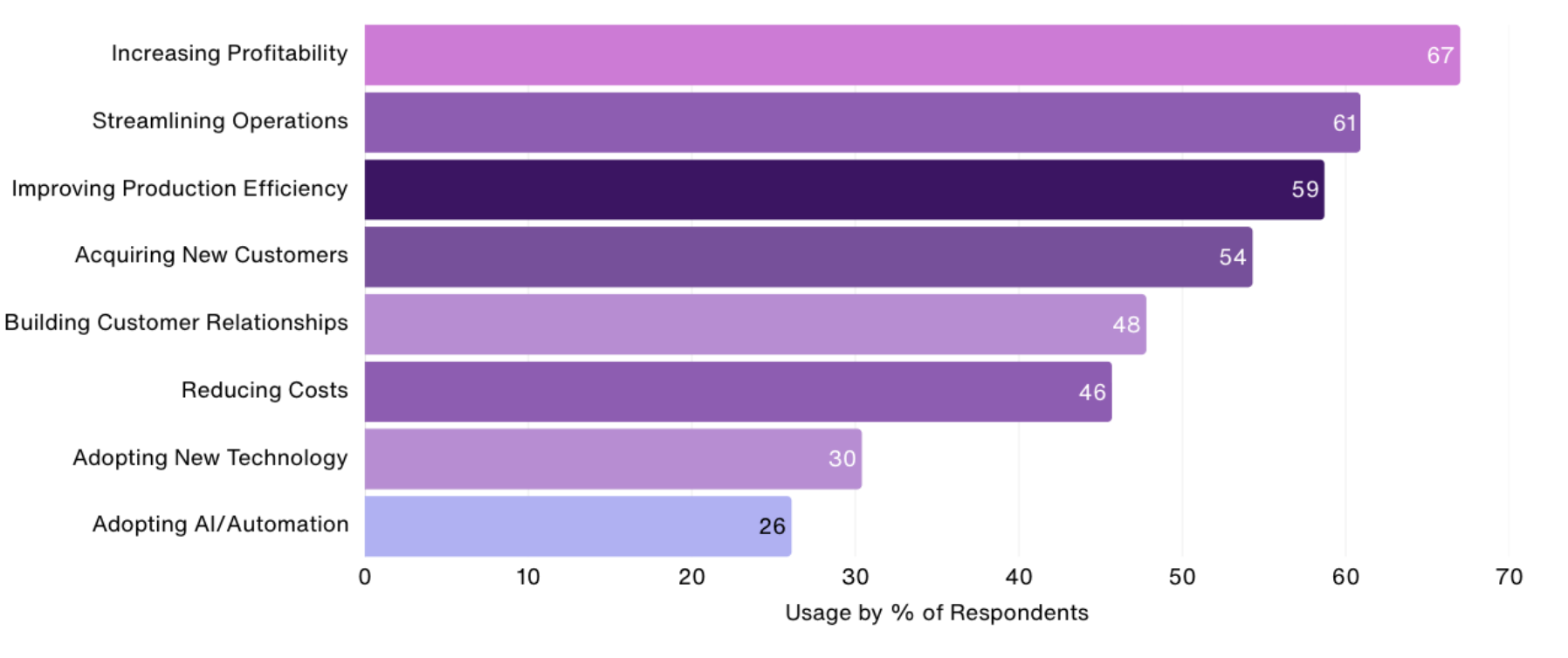
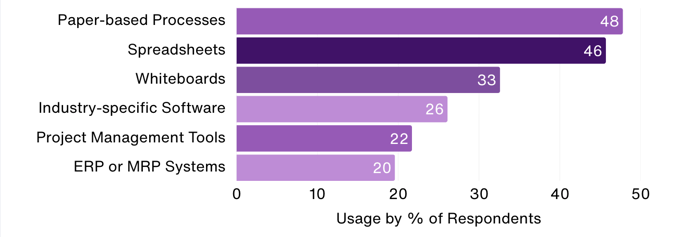
- Yet nearly half still manage production with paper (47.8%), and a third use whiteboards (32.6%)
That mismatch is the story. It’s also the fastest path to margin improvement for most shops.
What 2025 actually felt like on the ground
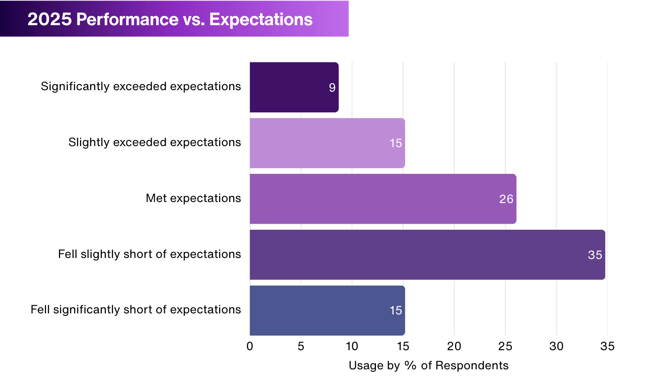
The survey paints 2025 as a year where many shops didn’t hit the number, but also didn’t fold.
The 2025 performance distribution shows a majority either fell short or met expectations, with only a smaller portion exceeding targets.
How has your business performed in the past 12 months compared to your expectations?
What’s notable is that the top challenges weren’t demand-side. They were margin-side.
What are the biggest challenges your business is currently facing?
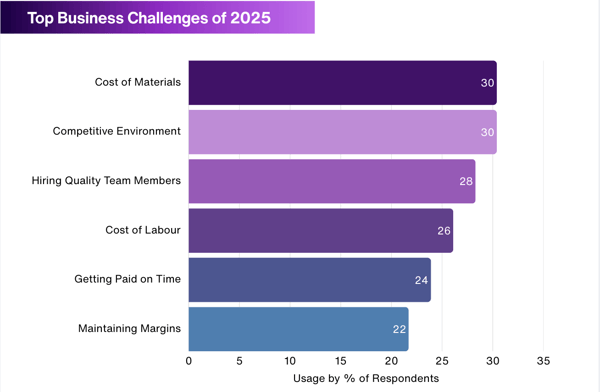
Busy is not the same as profitable. The survey reflects that reality.
The Digital Divide: the books are digital, the shop floor isn’t
One of the clearest charts in the report is also one of the most familiar.
- Accounting software adoption is near universal (about 96%)
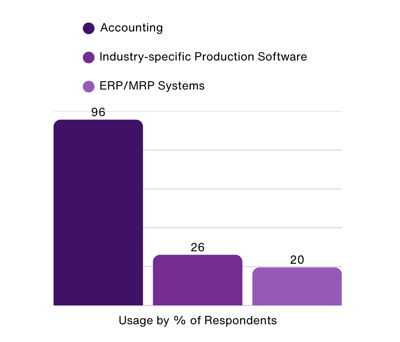
- But production tracking remains stubbornly analogue: paper, spreadsheets, and whiteboards dominate
What tools or systems do you currently use to manage your jobs and operations?
So you end up with a business where:
- invoices, payroll, and compliance are clean and trackable
- jobs, WIP, labour allocation, change orders, and rework live in someone’s head plus a clipboard
That’s not a judgement. It’s the bottleneck.
If your strategic priority is profitability, your highest leverage point is the part of the business where cost is created: the shop floor.
Why technology adoption is lagging (and it’s not because fabricators are anti-tech)
The report is blunt: tech providers scored 4.9 out of 10 in how well they serve SMB fabricators
The qualitative feedback is consistent:
- tools are over-engineered
- priced like enterprise systems
- designed for mass production, not jobbing and custom workflows
When asked what matters in software selection, usability is more important
How important are the following factors when choosing technology solutions for your business
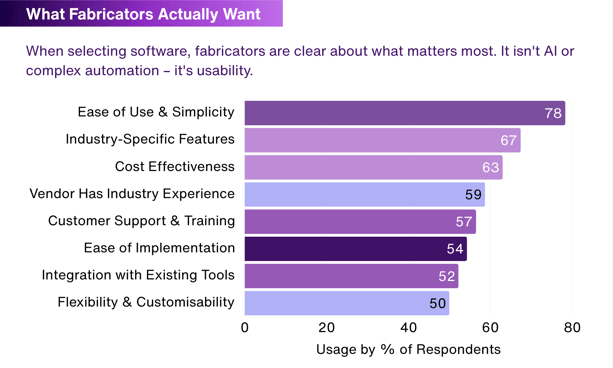
The “fundamentals over buzzwords” point is explicit: fabricators want solutions, not experiments.
The other problem nobody budgets for: the perception gap
Fabricators rated how well outsiders understand the industry at a paltry 4.0 out of 10!
This isn’t just frustration. It affects margins.
When customers underestimate complexity and time, you get:
- quote pressure
- lead time arguments
- undervaluing skilled work
A useful way to think about it:
- Operational efficiency protects margin internally.
- Customer education protects margin externally.
You need both.
A practical 2026 playbook: optimise before you expand
If you want a simple lens for 2026, use this.
Step 1: Stop margin leakage
Pick one leakage source and tighten it:
- rework
- missed change orders
- quoting variance
- material waste
- unplanned overtime
- poor scheduling and WIP visibility
Step 2: Make production trackable
Not “perfect”. Trackable.
Minimum viable upgrade:
- one source of truth for job status
- clear owners for each stage
- basic WIP visibility
- repeatable handoffs (quote to job, job to invoice)
Step 3: Build the customer narrative
If customers do not understand the work, you will always be compared on price.
Create a standard way to explain:
- what drives cost
- what drives lead time
- what changes when scope changes
Quick self-assessment: where are you strong, where are you exposed?
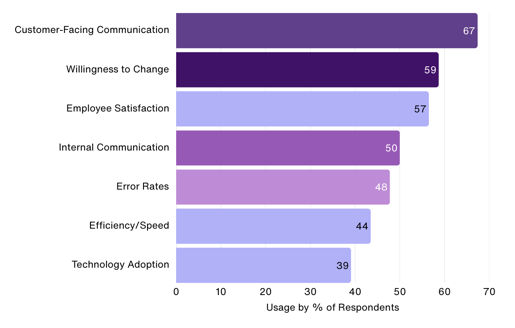
The report’s operational self-assessment is revealing:
- strongest area: Customer-facing communication (67)
- weakest area: Technology adoption (39)
How would you rate your team's performance?
Use this as a simple internal prompt:
If you had to improve only one thing this quarter, what would most directly increase profit?
- faster throughput
- fewer errors
- better scheduling
- better quoting discipline
- tighter change control
- clearer production tracking
- better cash collection
Then work backward: what system, habit, or role change would make that improvement unavoidable?
A simple checklist to run next week
The 60-minute “Efficiency Mandate” workshop (with your team leads)
- List your top 10 recurring job issues (late materials, missing drawings, rework, etc.)
- Rank them by cost, not by annoyance
- For the top 3 issues, define:
- the trigger (what starts the problem)
- the failure point (where it slips)
- the preventer (what must be true for it not to happen)
- Pick one preventer to implement this month
- Decide how you will measure it weekly (one number)
Do this monthly for a quarter and you will usually see real margin movement.
The bottom line
SMB fabrication is entering 2026 with a clear stance: bet on efficiency, not austerity.
Shops are willing to hire and invest, but they want simpler, fabrication-aware tools and better ways to protect margin in a world where costs and customer expectations are still under pressure (Summary, page 20).
If you want one takeaway:
Your biggest profitability upside is closing the gap between a digital back office and an analogue shop floor.
Source: State of the SMB Fabrication Industry Report (2025–2026), Factory.app
SUBSCRIBE TO STEEL & SENSE
Straight-talking advice for running a sharper, more profitable workshop.
Subscribe
SUBSCRIBE TO STEEL & SENSE
Straight-talking advice for running a sharper, more profitable workshop.
Subscribe
#1 PLATFORM FOR FABRICATORS
Learn more about Factory.app, the #1 platform for fabricators to create, track, plan and manage their jobs.
Chat to us